Original Text & Translation
山海經·西山經 · Shanhaijing · Classic of the Western Mountains · Wikisource
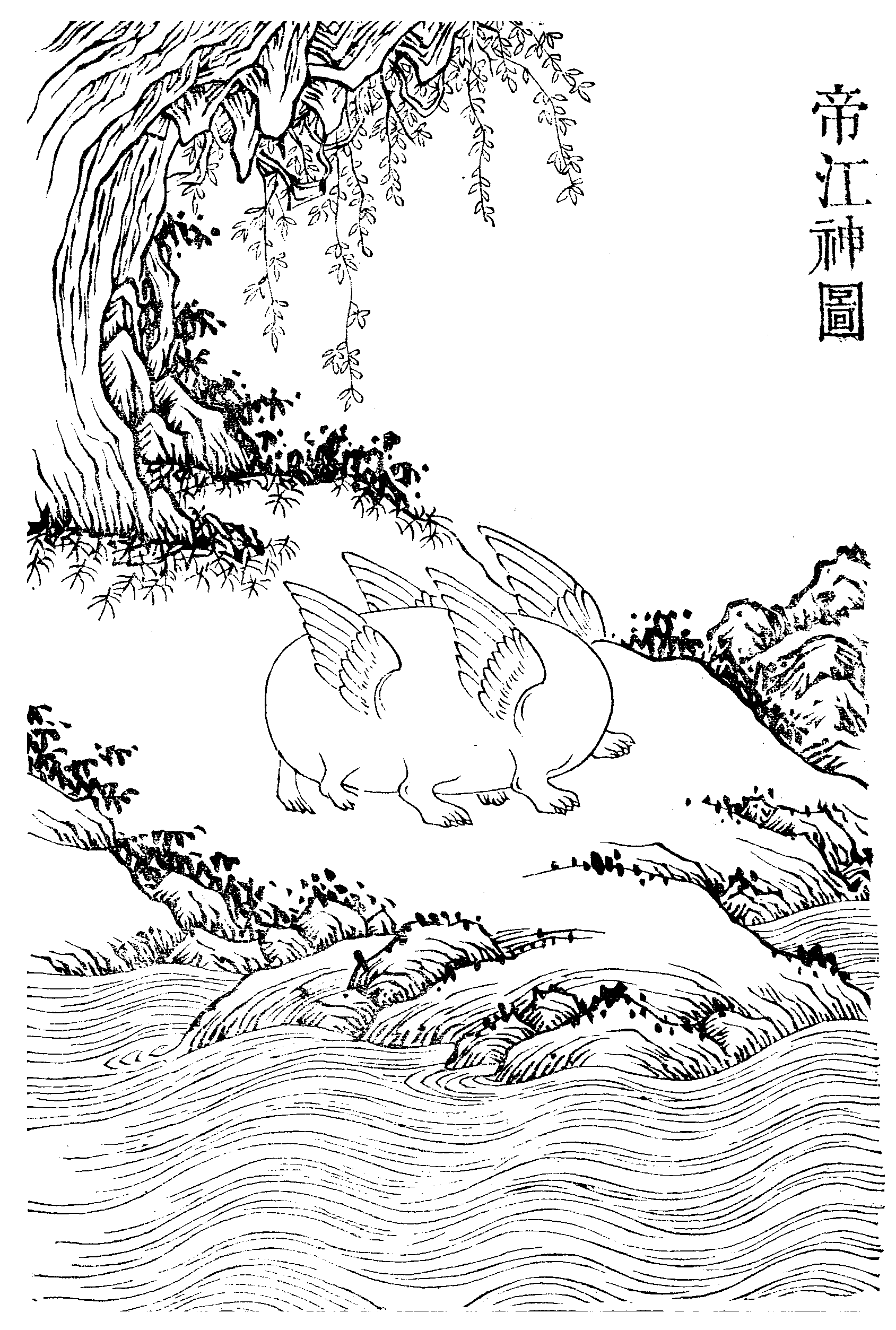
又西三百五十里,曰天山,多金玉,有青雄黃。英水出焉,而西南流注于湯谷。有神焉,其狀如黃囊,赤如丹火,六足四翼,渾敦無面目,是識歌舞,實為帝江也。
Three hundred and fifty li further west is Mount Tian, rich in gold and jade, with blue realgar. The Ying River rises here and flows southwest into the Hot Spring Valley. A god dwells here, shaped like a yellow sack and red as cinnabar fire, with six legs and four wings. It is a formless blur (hundun) without face or eyes, yet it knows song and dance. This is Dijiang.
莊子·應帝王 · Zhuangzi · Fit for Emperors and Kings · Wikisource
南海之帝爲儵,北海之帝爲忽,中央之帝爲渾沌。儵與忽時相與遇於渾沌之地,渾沌待之甚善。儵與忽謀報渾沌之德,曰:「人皆有七竅,以視聽食息,此獨无有,嘗試鑿之。」日鑿一竅,七日而渾沌死。
The emperor of the Southern Sea was Shu, the emperor of the Northern Sea was Hu, and the emperor of the Centre was Hundun. Shu and Hu often met in Hundun's land, and Hundun treated them very well. They plotted to repay his kindness: "All men have seven openings, to see, hear, eat and breathe. He alone has none — let us try boring some." Each day they bored one hole, and on the seventh day Hundun died.
Thematic parallel only: Zhuangzi does not name Dijiang. Later commentators link the faceless 渾敦 of the Shanhaijing with Zhuangzi's 渾沌.
Comparing the Books
The Shanhaijing describes a physical god with a 'hundun' (formless) body; Zhuangzi turns a faceless Hundun into a philosophical parable. The link is a traditional reading, not an explicit identification.