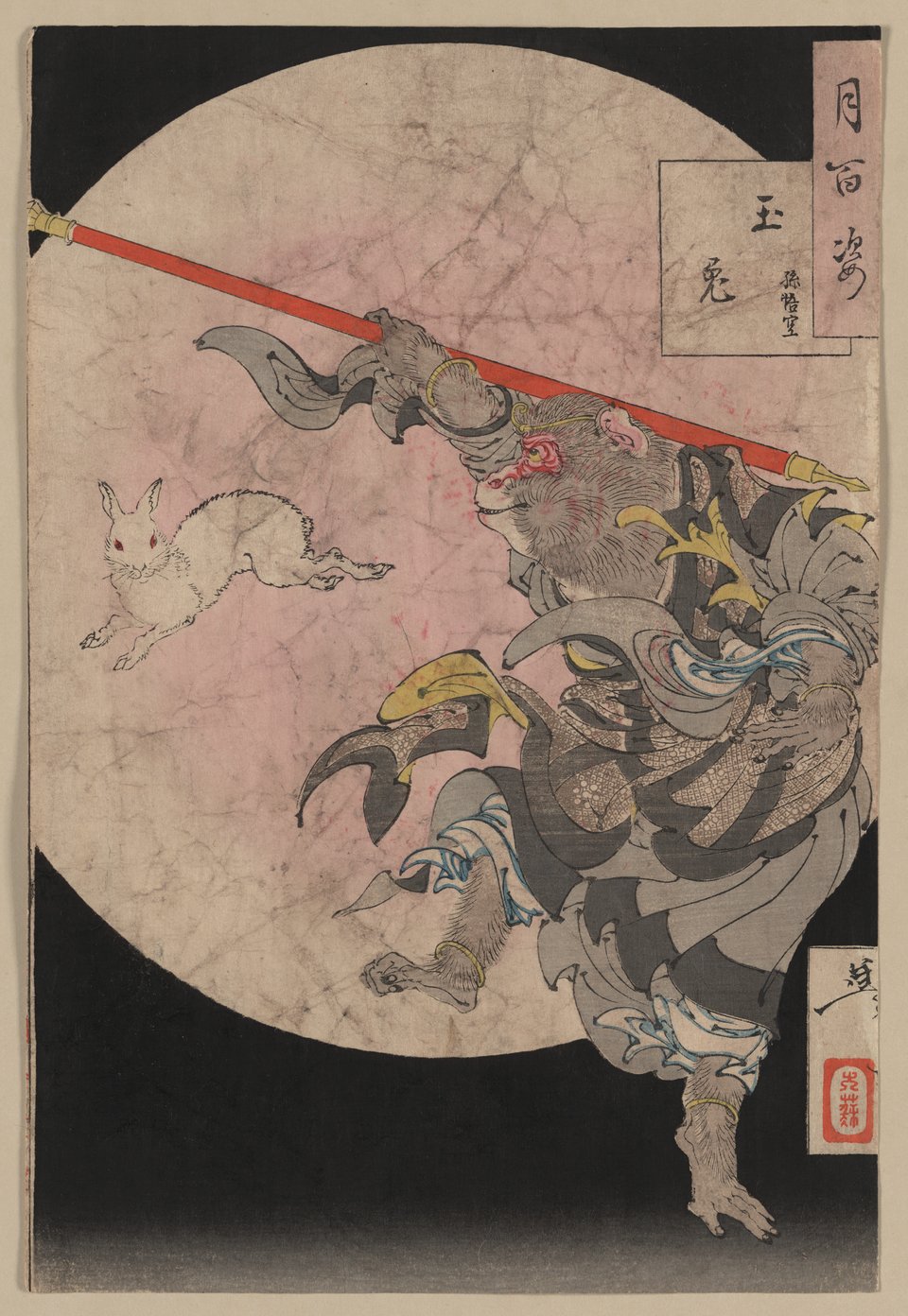
Who is Sun Wukong?
Sun Wukong is the Monkey King, the main character of Journey to the West, one of the four great classical novels of Chinese literature. The novel opens with his birth. A magic stone on top of the Mountain of Flowers and Fruit has soaked up the essence of heaven, earth, sun and moon for ages. It splits open, releases a stone egg, and the egg turns into a monkey whose eyes shoot beams of golden light up to the palace of the Jade Emperor.
He becomes king of the monkeys after leaping through a waterfall and finding the Water Curtain Cave behind it. Then, worried about death, he sets off across the sea to look for immortality. A Taoist patriarch gives him his religious name, Wukong (悟空), “awakened to emptiness.”
Why is he called the Monkey King?
The title comes straight from the text. After he finds the Water Curtain Cave, the monkeys bow to him as their ruler. The stone monkey drops the word “stone” from his name and calls himself 美猴王, the “Handsome Monkey King.” English translations often shorten this to “Monkey King,” and the name has stuck ever since. Arthur Waley’s famous 1942 abridged translation was simply titled Monkey.
Sun Wukong’s powers and abilities
Chapter 2 is where Wukong gets most of his famous skills. His teacher, the Patriarch Subodhi, offers him a choice between the 36 transformations of the Heavenly Ladle and the 72 transformations of the Earthly Multitude. Wukong, never modest, picks the bigger number and masters all 72 transformations. When the patriarch sees him struggling to fly, he teaches him the somersault cloud (觔斗雲), and a single somersault carries him 108,000 li.
More abilities pile up as the story goes on. After he gorges on the peaches of immortality, the elixir pills of Laozi, and heavenly wine, he becomes practically indestructible. Celestial weapons and thunderbolts bounce off him. Laozi tries to smelt him in the Eight Trigrams Furnace, and instead the smoke gives him his fiery golden eyes (火眼金睛), which can see through demons’ disguises. He can also pluck hairs from his body and turn them into copies of himself, and he can make himself enormous or tiny at will.
For a quick list of Sun Wukong’s abilities: the 72 transformations, the somersault cloud, hair clones, fiery golden eyes, superhuman strength, near-total invulnerability, and control over his staff’s size.
The staff: Ruyi Jingu Bang
Wukong’s weapon is the 如意金箍棒, usually rendered as the “As-You-Will Gold-Banded Staff.” In chapter 3 he visits the Dragon King of the Eastern Sea looking for a weapon, and nothing in the armoury is heavy enough for him. The Dragon King’s family points him to an iron pillar in the sea treasury, an old measuring rod said to have been used to fix the depth of the ocean. It shrinks when he asks it to. Engraved by its golden bands are the words: “As-You-Will Gold-Banded Staff, weight 13,500 jin.”
Its trademark trick is changing size. He can grow it as tall as the sky, or shrink it to the size of an embroidery needle and tuck it behind his ear. That’s why, in so many illustrations, the Monkey King seems to pull his weapon out of nowhere.
The golden headband
The headband (緊箍, the “tight fillet”) arrives in chapter 14, after Wukong has joined the monk Tang Sanzang. The bodhisattva Guanyin, disguised as an old woman, gives the monk a cap with a golden band inside and teaches him a secret spell. When Wukong puts the cap on and the monk recites the spell, the band clamps around his skull and he rolls on the ground in agony. He tries to pry it off with his needle-sized staff, but it has “taken root.”
The headband is the only thing in the novel that reliably controls him, and it carries an obvious meaning: the untamed mind brought under discipline. The novel even calls Wukong the “monkey of the mind” (心猿) in its chapter titles. Today the golden band is one of the most recognizable parts of his look, in costumes and tattoos alike.
Is Sun Wukong a god?
That depends on the stage of his story. He starts as a mortal animal who wins immortality through Taoist practice. Heaven tries to buy him off with a job, first as a lowly stable keeper (弼馬溫). When he learns how unimportant that is, he storms home and raises a banner proclaiming himself 齊天大聖, Great Sage Equal to Heaven, a title Heaven later grants him to keep the peace.
At the very end of the novel, once the pilgrimage is complete, the Buddha makes him the Victorious Fighting Buddha (鬥戰勝佛). So in the story's own terms he ends as an enlightened being. In Chinese popular religion the Great Sage is also worshipped in temples in some regions, especially in southern China and Southeast Asia.
Who can beat Sun Wukong?
Readers have argued about this for centuries. Here is what the book actually shows. In chapter 6 the god Erlang Shen fights Wukong to a draw in a duel of transformations, and Wukong is only captured after Laozi drops a diamond snare on his head and Erlang’s dog bites his leg. In chapter 7, after he escapes the furnace and wrecks the Hall of Divine Mists, the Buddha himself settles it. He bets Wukong can’t jump out of his palm. Wukong somersaults to what he thinks is the end of the world, sees five pillars, and writes “The Great Sage Equal to Heaven was here” on one. Then he learns the pillars were the Buddha’s fingers. The Buddha turns his hand into the Five Elements Mountain and pins him beneath it for five hundred years.
On the journey west, Wukong often needs help from Guanyin or other heavenly patrons to overcome demons who have stolen divine treasures. So the honest answer is that the Buddha beats him outright, Erlang Shen matches him, and plenty of well-armed demons give him serious trouble.
Sun Wukong in Journey to the West
Chapters 1–7 tell the Monkey King’s rise and fall, the most famous part of the book. Chapters 8–12 set up the pilgrimage: the monk Xuanzang (Tang Sanzang) is to travel from China to India to bring back Buddhist scriptures. In chapter 14 the monk frees Wukong from the mountain, and Wukong becomes his first and strongest disciple. The others are the pig Zhu Bajie, the river ogre Sha Wujing, and a dragon prince turned into a white horse. Together they face the 81 trials of the road west.
Sun Wukong and Black Myth: Wukong
In August 2024 the Chinese studio Game Science released Black Myth: Wukong, an action RPG for PC and PlayStation 5 built on Journey to the West. Players control a monkey warrior called the Destined One, who fights through famous locations and bosses from the novel and carries a staff modelled on the Ruyi Jingu Bang. The game was a major international hit and introduced many players outside China to the Monkey King’s story.
If the game got you curious, the novel is the best next step. Many of the bosses, places and weapons come straight from its chapters, and the original Wukong is funnier and stranger than any adaptation. Earlier pop-culture echoes include Goku of Dragon Ball, whose name is the Japanese reading of 悟空 and whose early story borrows the flying cloud and extending staff.
Sun Wukong tattoo ideas
The Monkey King is a popular tattoo subject, standing for rebellion, cleverness and hard-won self-discipline. Classic elements come straight from the novel: the golden headband, the staff, the somersault cloud, the Five Elements Mountain, and peaches of immortality. Japanese ukiyo-e prints, such as the Yoshitoshi print at the top of this page, are a common reference for a traditional look.
What Journey to the West says (original text & translation)
Key lines from chapters 1–7 and 14 of 西遊記, quoted from the public-domain text on Chinese Wikisource. Ellipses mark omitted lines. Translations are ours.
西遊記·第一回 · Chapter 1 — the stone monkey is born · Wikisource
西遊記·第一回 · Chapter 1 — the Handsome Monkey King · Wikisource
西遊記·第二回 · Chapter 2 — the 72 transformations · Wikisource
西遊記·第二回 · Chapter 2 — the somersault cloud · Wikisource
西遊記·第三回 · Chapter 3 — the staff · Wikisource
西遊記·第四回 · Chapter 4 — Great Sage Equal to Heaven · Wikisource
西遊記·第七回 · Chapter 7 — the Buddha’s palm · Wikisource
西遊記·第十四回 · Chapter 14 — the headband · Wikisource
Frequently Asked Questions
Who is Sun Wukong?
Sun Wukong is the Monkey King, the stone-born hero of the 16th-century Chinese novel Journey to the West. He rebels against Heaven, is imprisoned under a mountain by the Buddha, and is later freed to escort the monk Tang Sanzang to India.
What are Sun Wukong’s powers?
He knows 72 transformations, travels 108,000 li in one somersault on his cloud, turns his hairs into clones, sees through disguises with his fiery golden eyes, and is nearly invulnerable after eating the peaches and pills of immortality.
What is Sun Wukong’s staff called?
The Ruyi Jingu Bang (如意金箍棒), the “As-You-Will Gold-Banded Staff.” It weighs 13,500 jin and can shrink to the size of a needle or grow enormous.
Is Sun Wukong a god?
He starts as a mortal monkey who becomes immortal, calls himself the Great Sage Equal to Heaven, and at the end of the novel is made the Victorious Fighting Buddha. He is also worshipped in some Chinese folk temples.
Who can beat Sun Wukong?
In the novel the Buddha defeats him by trapping him in his palm and under the Five Elements Mountain. Erlang Shen fights him to a draw, and he is captured with Laozi’s help.
Why does Sun Wukong wear a headband?
Guanyin gave the monk Tang Sanzang a golden headband and a spell to control Wukong. When the spell is recited, the band tightens and causes him terrible pain (chapter 14).
Is Black Myth: Wukong based on Sun Wukong?
Yes. Game Science’s Black Myth: Wukong (2024) draws on Journey to the West. The player controls “the Destined One,” a monkey warrior who follows in the Monkey King’s footsteps.
_Tsuki_hyaku_shi_-_Tamausagi_songok%C5%AB.png)