Jiangshi meaning: what the word actually says
The word is two characters. 殭 / 僵 (jiāng) means stiff or rigid, the way a body stiffens after death. 屍 (shī) means corpse. So jiangshi is literally a “stiff corpse.” English speakers sometimes meet the word in its Cantonese form, geung si, because the best-known jiangshi films came out of Hong Kong.
The name says nothing about blood, bats or capes. It only describes a body that should be lying still and isn’t. That plainness is part of the creature’s appeal.
What is a jiangshi?
Put simply, a jiangshi is a dead body that gets up and moves around, usually at night, and attacks people. In classical Chinese thought a person has a higher soul (hun 魂) and a lower, more physical soul (po 魄). Writers of the Qing dynasty (1644–1912) argued about what made a corpse move. Was it the lingering po? Was it some outside evil that had taken over the body?
The scholar-official Ji Yun (紀昀, also known as Ji Xiaolan) gave one of the clearest descriptions. He said there were two kinds: a fresh corpse that had not yet been put in its coffin and suddenly leapt up to grab people, and a body buried for a long time that never decayed and turned into something like a mountain demon, coming out at night to snatch anyone it met. He then admitted he couldn’t explain how either could happen. The full passage is quoted below.
Jiangshi vs. vampire: is it really a “Chinese vampire”?
The label “Chinese vampire” stuck because the Western vampire was the nearest thing English audiences already knew. Both are corpses that come back and prey on the living, and both rise at night and retreat at dawn.
The differences are bigger, though. The classical jiangshi has no aristocratic charm and doesn’t seduce anyone. In the stories we checked, drinking blood is not its defining habit either. It grabs, crushes and bites with brute strength. In one story by Yuan Mei, a jiangshi bit a temple statue hard enough to snap the god’s weapon into three pieces. Its weaknesses also differ. There’s no garlic or crucifix. Instead the sources mention bells, the stolen coffin lid, the rooster’s crow and fire. “Hopping vampire” is a handy shorthand, but the jiangshi is really its own kind of monster.
The Chinese jiangshi in Qing-dynasty ghost stories
Most of what we can read today about the jiangshi comes from two famous 18th-century collections of strange tales (zhiguai 志怪). Ji Yun’s Notes of the Thatched Abode of Close Scrutiny (閱微草堂筆記) and Yuan Mei’s What Confucius Did Not Speak Of (子不語) both have several corpse stories. Both books are long out of copyright, and full texts are on Chinese Wikisource.
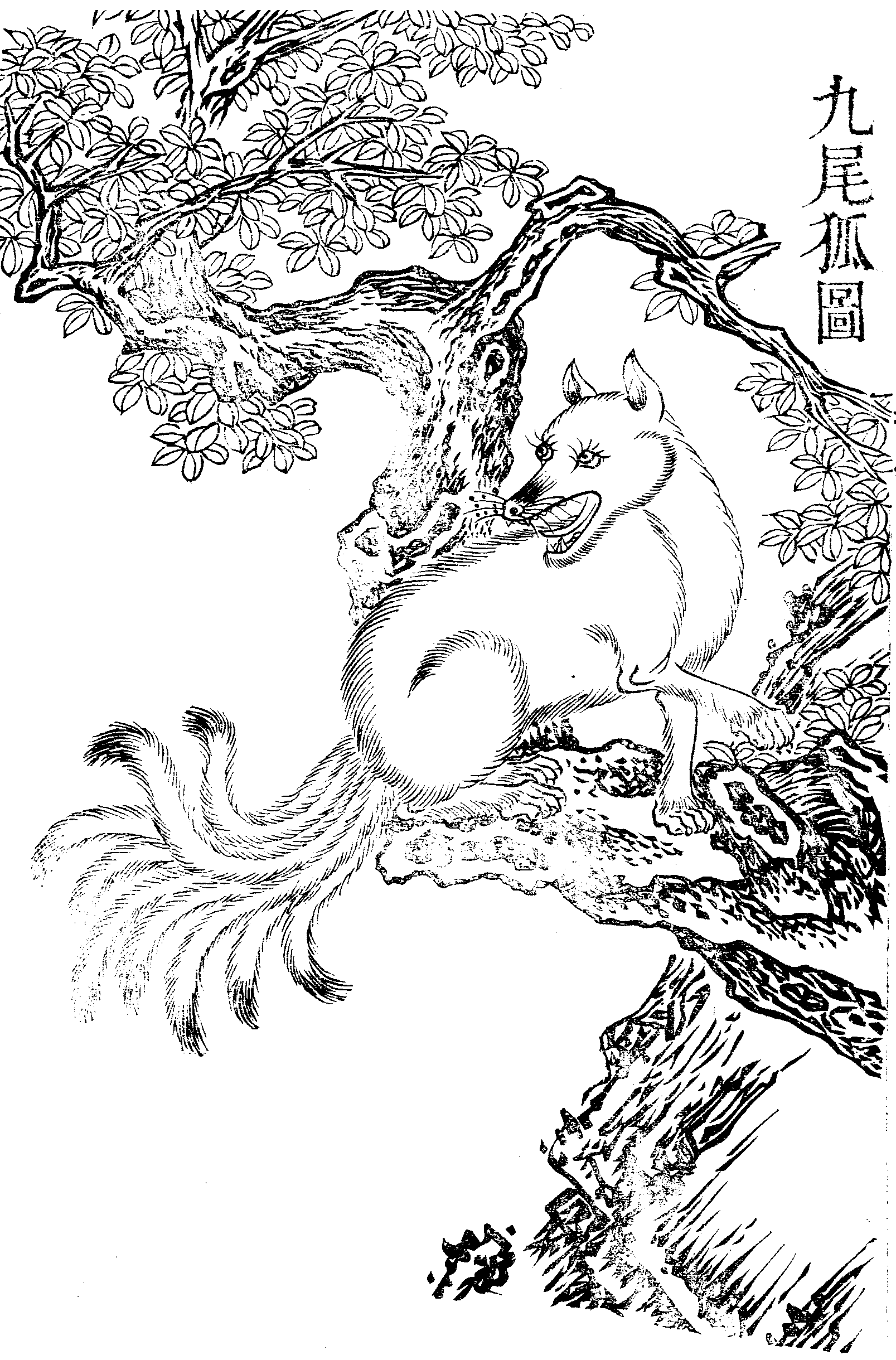
Their jiangshi are surprisingly varied. One flies through the air and carries off village children. Another, a plague victim whose body hadn’t been coffined yet, chases a traveller across a field. A third is covered in white fur like a coat turned inside out, with green light in its eyes. One pair of jiangshi even meets for a secret love affair. None of these stories describes the creature hopping. That image belongs to later folklore and, above all, to cinema.
Jiangshi talisman: the yellow paper on the forehead
In films a Taoist priest stops a jiangshi by slapping a strip of yellow paper, inked with red characters, onto its forehead. While the charm stays put, the corpse freezes. These talismans (fu 符) are a real part of Taoist ritual practice, where written charms are used for protection and exorcism.
The classical tales we quote use other methods. In Yuan Mei’s “Flying Jiangshi” a Taoist tells villagers that “jiangshi fear the sound of bells above all,” and a brave man shakes two bells all night at the mouth of the creature’s lair. Another story notes the belief that a jiangshi that has lost its coffin lid can no longer do harm. So the forehead talisman is best read as the modern, cinematic form of a much older idea: a corpse can be controlled by ritual.
Why does a jiangshi hop?
The hop is a mostly modern image, and nobody can say for sure where it started. One popular explanation points to the folk tradition of “corpse driving” (gan shi 趕屍), associated with western Hunan. In these tales, specialists were said to guide the bodies of people who had died far from home back to their native villages, moving them by night. Stiff bodies, a line of figures moving in rhythm, and a ringing bell make a natural seed for the hopping jiangshi. Treat this as a theory, though, not established history.
Jiangshi costume and outfit: why the Qing official’s robe?
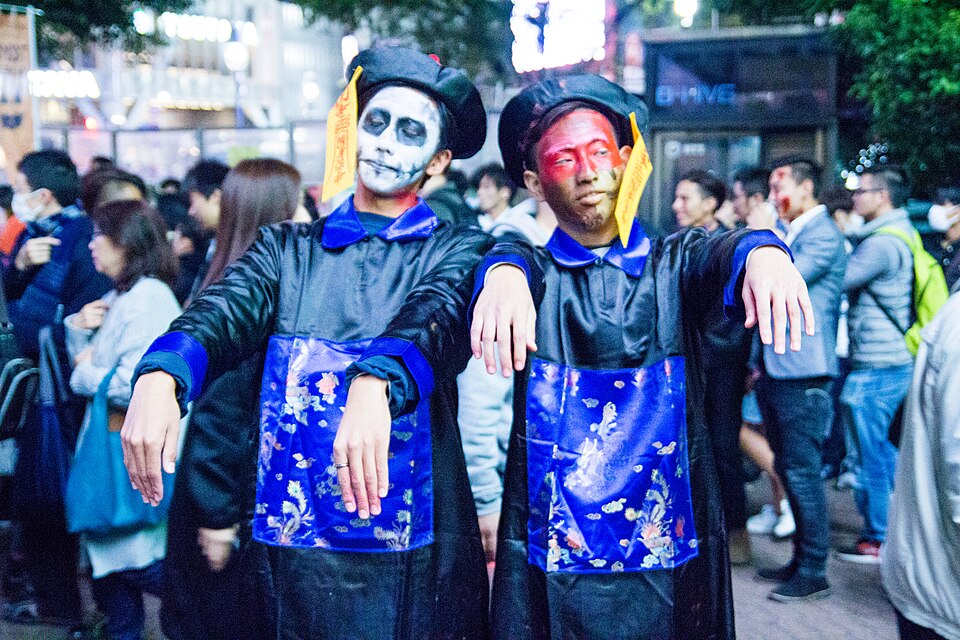
The classic jiangshi outfit is a long dark robe with a square embroidered badge on the chest, a round hat topped with a bead and trailing a peacock-style plume, and the yellow forehead talisman. It’s essentially the court dress of a Qing-dynasty official. That fits the films, which are set in the late Qing, when the dead would have been buried in exactly these clothes.
For a convincing costume: dark robe or long changshan, a round official’s hat, pale face makeup with grey or green shading around the eyes, long fingernails, and a paper talisman. Hold your arms straight out and you have the pose. The photo at the top of this page shows a typical Halloween version.
Jiangshi movies: Mr. Vampire and the Hong Kong boom
The modern jiangshi was largely shaped by Hong Kong cinema. The landmark film is Mr. Vampire (殭屍先生, 1985), directed by Ricky Lau and produced by Sammo Hung. Lam Ching-ying plays a stern, one-browed Taoist priest who fights the hopping dead with talismans, sticky rice and chicken blood. Its hit mix of horror, kung fu and slapstick launched a run of sequels and imitators in the late 1980s, and Lam Ching-ying became the defining jiangshi-hunter on screen.
Later films looked back at the genre with nostalgia. Rigor Mortis (殭屍, 2013), directed by Juno Mak, was made as a darker homage and cast actors from the original films. Today the jiangshi shows up in video games, anime and Halloween costumes worldwide. Nearly all of that traces back to the 1980s Hong Kong look, not the white-haired corpses of the Qing tales.
What the classical sources say (original text & translation)
Every passage below is quoted from the public-domain texts on Chinese Wikisource and linked to its chapter. Translations are ours.
閱微草堂筆記·卷十 · Ji Yun, Notes of the Thatched Abode of Close Scrutiny, vol. 10 · Wikisource
閱微草堂筆記·卷七 · Ji Yun, vol. 7 — the physician Hu Gongshan’s encounter · Wikisource
閱微草堂筆記·卷七 · Ji Yun, vol. 7 — on the drought demon · Wikisource
子不語·卷十二·飛僵 · Yuan Mei, What Confucius Did Not Speak Of, vol. 12, “The Flying Jiangshi” · Wikisource
子不語·卷二十二·僵屍抱韋馱 · Yuan Mei, vol. 22, “The Jiangshi That Hugged Weituo” · Wikisource
Frequently Asked Questions
What does jiangshi mean?
Jiangshi (殭屍) means “stiff corpse.” 殭/僵 means stiff or rigid and 屍 means corpse. The Cantonese pronunciation is geung si.
What is a jiangshi?
A jiangshi is a reanimated corpse from Chinese folklore that attacks the living. Qing-dynasty writer Ji Yun described two kinds: fresh corpses that leap up and seize people, and long-buried bodies that never decay and roam at night.
Is a jiangshi a vampire?
It’s often called the “Chinese hopping vampire,” but it’s a different creature. Classical jiangshi grab and bite with brute strength rather than seducing victims and drinking blood. Their weaknesses in old stories include bells, dawn and fire, not garlic or crosses.
Why do jiangshi hop?
Hopping is mostly a modern image made famous by 1980s Hong Kong films. A popular theory links it to folk tales of “corpse driving” (趕屍) in Hunan, but the 18th-century ghost stories quoted on this page don’t describe hopping.
What is the paper on a jiangshi’s forehead?
It’s a Taoist talisman (符): yellow paper with characters written in red. In films it freezes the jiangshi. Older stories use other controls, such as ringing bells.
What are the best jiangshi movies?
The genre classic is Mr. Vampire (1985), directed by Ricky Lau and starring Lam Ching-ying, followed by its sequels. Rigor Mortis (2013) is a modern homage.